Showroom Floors Under Storefront Glass.
In a Pelican Bay showroom the floor sits in every customer’s line of sight, lit by display lights and by the sun coming through the front windows. We build sales floors that hold an even gloss from the door to the back wall and stand up to fixtures moving every season.
Daylight through the front, spots overhead.
Retail spaces in the Pelican Bay commons have a problem a garage never does: the floor gets lit from two directions at once. Daylight comes through the storefront glass low and bright, track and display lights hit the floor from above, and a high-gloss finish throws both straight back at the customer. Get the sheen wrong and the area just inside the door turns into a sheet of glare, while every scuff in the aisle shows.
We control glare with the finish level. A full gloss looks right deep in the room under display lighting. Near the glass, we can talk through a lower-sheen top in the same color. At the walkthrough we lay sample boards down in your actual light, at more than one time of day when it matters, because a finish that looks perfect on a counter can read very differently at the storefront.
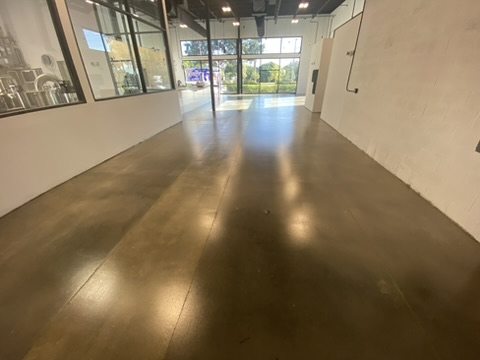
Reading the length of a room
A narrow sales floor with glass at one end is the hardest kind to get right, since the eye travels the whole length and any change in sheen shows up as a band. We grind the full slab to CSP-2 first so the base is uniform, then roll each coat across the room in continuous passes, keeping a wet edge that never sits long enough to set. Patchy gloss nearly always starts with patchy prep or a stopped edge.
Choosing a finish for the sales floor.
Three finishes suit most showrooms we coat, and the product on display usually decides between them.
Metallic
Swirled pours over diamond-ground concrete, so no two rooms come out alike. The pick when the floor is part of the look, as with furniture, lighting and design goods.
Flake
Colored chips broadcast under a clear top. Hides scuffs and tracked sand, and suits a busy floor where traffic counts for more than the floor drawing the eye.
Solid Color
One even color, often scored into a grid. Quiet enough to let the merchandise lead, and the easiest of the three to keep uniform down a long room.
A scored grid that passes for tile.
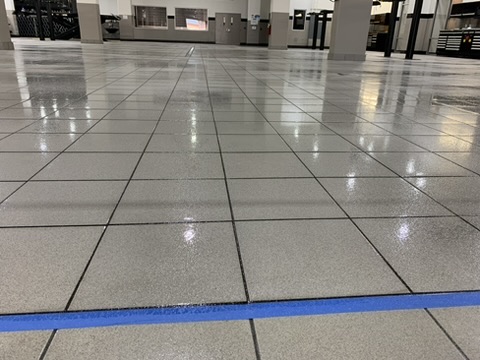
Some owners want the look of large tile without grout lines that crack and hold dirt. We get there by cutting a grid into the prepared slab before coating. The coating flows down into the scored lines, and under the gloss they read as joints. Spacing and layout are settled at the walkthrough so the grid lines up with your doors, your fixture runs and the display walls.
Lines that stay put
Because the grid is cut into the concrete, the lines live beneath the coating and cannot wear away. Tape lines for color breaks work the same way: they go down between coats and the top seals over them. A dealership service floor or a showroom with a marked walkway keeps its striping without anyone repainting it.
What rolling racks do to a floor.
Most wear on a showroom floor comes from what gets moved across it. Every reset sends gondolas, display tables and rolling racks over the same paths, and a thin coating shows it quickly as gray scuff lanes and chips where a fixture foot got dragged. These are the things we build a sales floor to handle:
- Rolling racks and carts, whose hard casters press their whole weight into a small spot.
- Loaded fixtures dragged into place, which gouge a soft floor and barely mark a hard one.
- Ladders and lifts brought in for display work, standing on just a few points.
- Sand tracked in from the beach and the parking areas, working on the gloss like fine sandpaper.
All of that is why the build matters under the shine: 100% solids material on a CSP-2 grind, with a hard topcoat as the wear layer. The topcoat is what keeps the gloss even through season after season of resets. When a busy lane does start to dull, a light scuff and a fresh topcoat bring it back without starting the floor over.
Coating the floor during a store reset.
The cleanest moment to coat a sales floor is while the store is between layouts. The fixtures are coming out anyway, and the room sits empty for the grind. We plan the job around your reset dates and agree on the order of rooms in advance, so a stockroom or back office stays in use while the sales floor gets done. On the day we install, we tell you when your people can walk on it and when the fixtures can go back.
Shops in the commons often sit next to restaurants and service spaces, and those need different systems. Kitchens and food-service rooms are covered on restaurant flooring, dry stockrooms may suit polished concrete, and a garage at home usually means flake epoxy or polyaspartic. The showroom flooring page explains how we build sales floors in general, our Pelican Bay service page covers local work, and there are photos in the project gallery. To talk about your space, call (239) 300-0546 or send us the details.
Close to home for our crew.
Pelican Bay sits ten minutes from our base in Naples. The onsite visit and the written quote cost you nothing, and there is no travel surcharge.

Fourteen years on Southwest Florida concrete. Store owners in Pelican Bay deal with one family-run company from the first walk of the space to the final coat.
Showroom questions from Pelican Bay owners.
Six that come up whenever the floor is part of the display. Ask about your space.
Will a high-gloss floor glare under our storefront windows?
Metallic, flake or solid color: which works best on a sales floor?
Can you make the floor look like tile?
How does the finish hold up to rolling racks and fixtures?
How do you keep the shine even across a long room?
Can the floor go in during our store reset?
Pelican Bay, FL
See the samples in your own light.
Free onsite quote for showroom and retail floors in the Pelican Bay commons. We bring finish samples to the space and judge them under your lights before anything gets decided. A written quote follows within 24 hours, and nothing gets signed on the first visit.
Monday to Saturday, 8a to 6p

Epoxy Guys LLC
Better than two million square feet installed across Southwest Florida from our base in Naples.