Traction, Sized Per Surface.
Screened lanais, community clubhouse paths, restaurant back-of-house, covered loading entries. Four very different floors that all go slick for different reasons. Epoxy Guys pick the grit for each one instead of running a single texture across the whole property.
Traction work in Estero splits neatly along the same line the city itself does. On one side sit the master-planned communities, thousands of homes with screened lanais and pool surrounds plus the shared amenity buildings that serve them. On the other sit the retail and medical corridor near Coconut Point and the newer commercial growth along Corkscrew and US-41, where the wet floors are kitchens, service corridors and covered loading entries.
Those two worlds fail differently. A lanai goes slick from biology: shade under the screen, damp that lingers, and a film that thickens quietly until someone’s heel finds it. A kitchen goes slick from chemistry, a mix of grease and rinse water that will glaze right over a texture that was never sized for it. A clubhouse walkway takes both, plus volume, since a few hundred residents a week polish the traffic lane smooth long before the edges wear at all.
So the useful first question is not how rough you want the floor. It is what puts water on it, what rides in the water, and who walks through. Answer that per area and the grit choice follows. Call (239) 300-0546 or tell us what you are dealing with and we will come walk each space.
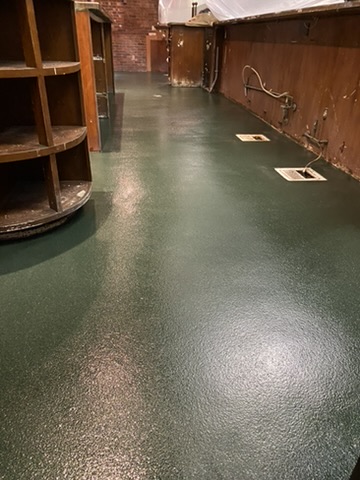
Grit size is a traffic decision.
Aggregate comes in grades, and the grade you want is the one matched to the shoes crossing it. Bare feet on a pool surround want fine particles, closely spaced, so the bite arrives without anything sharp. Rubber-soled kitchen clogs want a coarser grade, because a shoe already has tread and the floor’s job is to keep working once grease fills the gaps between it. A loading area taking hand trucks and wet boots wants coarser still.
Broadcast rate is the second dial, and it does at least as much work as grade. The same aggregate laid heavier gives a surface that reads noticeably more aggressive underfoot, which lets us tune one product across several areas rather than stocking four. That matters on an amenity building where the pool surround, the covered walk and the equipment room all deserve different answers. We spell out both the grade and the rate for every zone on the walkthrough, and you get a written free quote that lists them area by area.
Five decisions, in order.
Every one of these lands before the resin does. Texture is not something you can add to a floor after it cures.
Zone the property
We divide the job into areas that share a wetting cause and a shoe type. A pool surround, a covered walk and a kitchen line are three zones, never one number applied everywhere.
Open the slab
Diamond grinding, failed coatings removed, cracks cut and filled. Grit broadcast over a bond that is already failing gives you a textured floor that peels off in sheets.
Match grade to shoes
Fine where feet are bare, coarser where boots and carts run. We bring panels in a few grades to the walkthrough so nobody is choosing texture from a description.
Dial the rate
How much aggregate lands per square foot sets the final feel. We hold the rate steady across a zone so the floor does not change bite halfway through a room.
Lock and seal
A topcoat encapsulates the particles so traffic cannot sweep them loose, and leaves a surface a brush can clean without fighting it. Outdoors that topcoat is our UV-stable system.
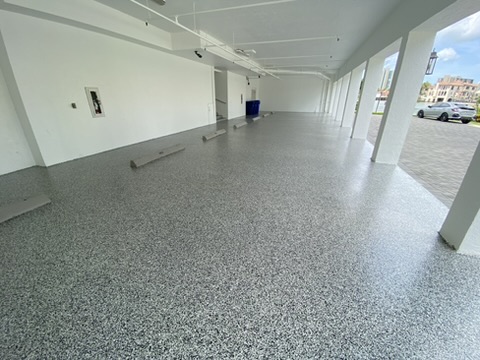
Cleanable enough to stay grippy.
Grip and cleanability pull against each other, and pretending otherwise is how facilities end up with floors nobody can maintain. Deeper texture holds more soil, and soil is exactly what turns a traction floor back into a slick one. The floor that stays safest over five years is rarely the roughest floor. It is the one whose crew can actually get it clean on the schedule they keep.
So tell us who cleans it and how often, and we will build to that: a kitchen scrubbed nightly with a deck brush can carry real grit, while a clubhouse walk that sees a hose and a broom needs a texture a hose and a broom can win against.
Sun is the other constraint out here. Ultraviolet light does not touch the aggregate, but it goes hard after the resin locking it down, and a standard interior topcoat on a west-facing walk chalks and starts shedding grit. Exterior zones get the UV-stable outdoor system for that reason. If you are also weighing a pool deck coating or a garage floor on the same property, we price them together in one visit. Recent installs are in the project gallery.
What boards and managers actually need.
When an HOA board or a facility manager calls us, the trigger is usually an incident report or an insurance letter, and the question arrives as a number: what rating will this floor hit. We answer that carefully. Published traction figures come from lab panels, and a lab panel is not a clubhouse walk with sunscreen, mulch and pollen on it. Any contractor who guarantees a specific field number on a surface they have not built yet is guaranteeing something outside their control.
What we can put in writing is the spec: which aggregate grade, at which broadcast rate, under which topcoat, in which zone. Pair that with accessible-route requirements, where a firm, stable, slip-resistant surface is the standard, and you have a defensible record. A resin system with encapsulated aggregate meets that description in a way a smooth sealed slab does not.
The part that gets skipped is maintenance. Traction is a shared job between the floor and the cleaning schedule, and a board that logs both is in far better shape than one holding a single test result from install day. We tell boards this plainly, even when a competing bid is waving a bigger number around. For a shared kitchen or a fitness room, our commercial epoxy work covers the same ground; for lobbies and social rooms where appearance leads, see metallic epoxy.
On the schedule already.
Estero sits in our primary service area and on the route most weeks, so a walkthrough here rarely takes long to schedule. No travel surcharge.
Traction jobs here run from a single screened lanai to a phased commercial floor, and both start the same way: we walk it, zone it, and hand you a written price per area. Reach us at (239) 300-0546 or through the contact form. Every install carries the same lifetime adhesion warranty as the rest of our Southwest Florida work, and how we build traction generally is covered on the main anti-slip coatings page.

Family-owned out of Naples since 2012. Traction floors in Estero, FL get the same prep, the same chemistry and the same warranty as everything else we install.
Asked on Estero walkthroughs.
Six that come up whether we are standing in a lanai or a kitchen. Ask us anything else.
Our HOA board wants a traction number for the clubhouse walkway. Can you give one?
Does a coated kitchen floor need to be rough enough to hurt?
How do I know whether my lanai needs new texture or just a wash?
Will outdoor texture in Estero fade or chalk in the sun?
Can a restaurant stay open while the back-of-house is coated?
What does a facility manager need to document about a slip fix?
Estero, FL
Walk it with us first.
Bring us the lanai, the amenity building, the kitchen or the loading door. We zone the property, size the grit for each area, and put the price in writing before anything is scheduled.
Call or text any time

Epoxy Guys LLC
A Naples family business since 2012, coating garages, lanais, and storefronts across Southwest Florida.