Commercial Epoxy Estero.
Storefronts, kitchen lines, exam rooms, hangars and warehouse aisles get resinous floors built around your trading hours. Epoxy Guys phase the work so the room keeps earning, and hand it back on the hour we promised at the walkthrough.
Storefronts, kitchens, and exam rooms.
The commercial corridor here runs along US 41 and Corkscrew, and the buildings on it hold a mix that almost nothing else in Lee County matches: retail suites at Coconut Point, restaurant space behind them, medical and dental offices a few doors down, and warehouse and hangar floors a short drive away. Every one of those rooms wants resin on the slab for a different reason, so we spec them differently even when the base chemistry is shared.
A retail floor is judged with the lights on and the doors open. It takes cart wheels, dolly traffic on delivery mornings, sand tracked in from the parking lot, and a mop most nights, so the surface has to stay presentable under all of that without turning slick when somebody comes in wet. We keep the texture subtle in the customer-facing half and step it up behind the counter and in the stockroom, where the traffic and the spills actually live.
Behind the swinging door
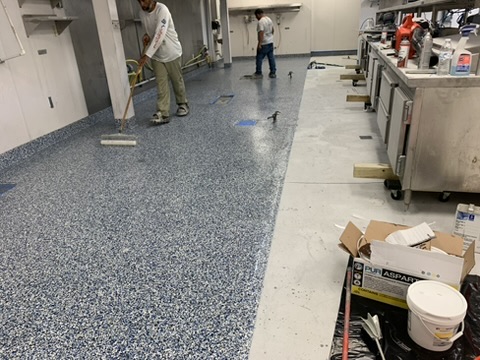
Kitchen floors take the hardest treatment of anything we coat in this town. Hot water, degreaser and a deck brush every night after close do more damage than a full dinner service, and the joint where the wall meets the slab is where it starts. We form a cove up the wall so nothing pools in that corner, correct the fall so water reaches the drain instead of sitting in a low spot, and pick a topcoat that answers to cleaners rather than to gloss.
Medical and dental suites are the quiet opposite. Nobody hoses those floors down, but they get disinfected on a schedule and inspected by people who look at corners. Seamless matters there because there is no grout line to trap anything, coved corners matter because a mop should reach every inch, and color matters more than owners expect: a calm mid-tone reads clean under exam lighting where a bright white shows every scuff by Wednesday.
Four rooms, four builds.
What changes between an Estero sales floor and a hangar bay is thickness, texture, and where the resin stops.
Sales Floors and Stockrooms
Cart wheels, delivery dollies, and parking-lot grit. Subtle texture out front, heavier build behind the counter, and a finish that mops clean overnight.
Kitchen Lines and Dish Pits
Cove formed into the wall joint, slope reset so water finds the drain, and chemistry answering to degreaser rather than to shine.
Medical and Dental Suites
Seamless with no joints to hold anything, coved corners a mop can reach, and quiet color that stays looking clean under exam lights.
Hangars and Warehouse Aisles
Forklift wheels, pallet jacks, and tow bars. Extra film through the drive lanes and door approaches, with striping locked under the topcoat.
The spec walk and what follows.
Five moves, in this order, whether the room seats sixty or parks an airplane.
Walk it with your manager
An hour with whoever runs the room. We map traffic, drains, delivery times, and the door our crew can use, and collect any landlord requirements before pricing.
Set the phasing calendar
We fit the work to your trading hours and your season, splitting the room in halves or running overnight, and put the hand-back hour for each phase in writing.
Strip and open the slab
Old covering, adhesive, and tired coating come off mechanically. Diamond grinders in tight suites, shot blast on open warehouse and hangar floors.
Repair, cove, and stripe
Bare slab gets tested, spalls patched, fall corrected toward drains, cove formed where wash-down reaches, and aisle lines laid before the coats close over them.
Topcoat and reopen
Final coat matched to your return time, then a walk with your manager covering when staff can walk it and when racking and equipment go back.
Hangars, warehouses, and wheel loads.

The heavier end of our commercial work near Estero is aviation and light warehouse space, and those two share a problem retail never has: point loads. A nose wheel, a tow bar, a loaded pallet jack and a forklift caster all press their weight through a very small contact patch, and they do it in the same lanes every day. So we build those floors from the traffic map outward, laying extra film through drive aisles, door approaches, and the strip in front of the roll-up where everything pivots.
Gloss earns its keep in a hangar. A bright reflective floor throws the overhead light back up under wings and fuselage, which is where technicians actually need to see, and it makes a dropped fastener findable instead of lost. Warehouse floors want the opposite conversation. There we talk about abrasion life, how the aisles should be striped, and whether the racking positions are settled, because lines laid between coats are protected for good and lines painted on top get scuffed off by the first quarter’s traffic.
Chemical exposure decides the rest. Hydraulic fluid, fuel, solvent and battery acid each attack a coating differently, so we ask what actually gets spilled in the building and spec against that list rather than a generic one. Same for wash-down: a floor that gets pressure-washed monthly is built differently from one that gets swept. Other floors on the property? Look at garage and shop floor coatings, anti-slip coatings, metallic epoxy, and pool deck coatings, or the warehouse flooring page for how these systems are built. Everything we install locally is on the Estero service page, and recent work is in the photo gallery.
Working around your calendar.
Estero runs on a season, and pretending otherwise is how a floor project turns into a bad quarter. Retail and restaurants are at their busiest when the winter residents are here, medical offices fill up in the same stretch, and nobody wants a grinder running through it. So the first real question at a walkthrough is not what the floor should look like. It is when the room can afford to be quiet, and how much of it can be quiet at once.
Return time drives the chemistry, not the other way around. If you need staff walking the floor in eight hours we spec for that, and we tell you plainly what it costs in load capacity later. If the room can rest a weekend, we can build something heavier. Either way the hours go in writing before anyone starts. Bring your operations manager to the walkthrough and call (239) 300-0546, or send the suite address through the project form and we will come look.
Where we work in town.
Estero sits on our standing Lee County route. Free onsite walkthrough, no travel fee, and the same crews that run our Naples jobs.

Installing on Southwest Florida slabs since 2012. Estero, FL business owners get the same prep standard and the same crews we send to every other job on the route.
What Estero operators ask first.
Six questions that come up on nearly every commercial walkthrough here. Ask us anything else.
Do you have to close the store while the floor goes in?
Our busiest months are January through April. When should we schedule?
How fast can we put racking and equipment back on it?
Will a coated floor survive forklift and pallet-jack traffic?
Can you stripe aisles, bays, and safety zones into the floor?
Who should meet your crew for the site walk?
Estero, FL
Put a date on the Estero floor.
Free onsite walkthrough for commercial floors in Estero. We map the prep, spec the system around your hours, and put the whole scope in writing for you or your landlord. Epoxy Guys, on Southwest Florida slabs since 2012.
Call or text any time

Epoxy Guys LLC
Better than two million square feet installed across Southwest Florida from our base in Naples.