Garage Floors Built For Cape Coral Slabs.
Sand under the slab, canal water a short walk away, and humid air nine months of the year. Epoxy Guys read the concrete before quoting it, then build a floor that suits what the slab is actually doing.
The slab decides the system.
In most of the country moisture is a footnote on a garage floor quote. In Cape Coral it is the first thing we look at and the thing that sets everything after it.
Cape Coral is roughly 224,000 people spread across sandy ground threaded with something on the order of 400 miles of canals. That geography has a direct effect on garage floors. Sand drains fast but holds water close, and the water table sits high enough that a slab on grade is often only a couple of feet above wet ground. Water does not need a crack to get through concrete. It moves upward through the pores as vapor, quietly, all day, and it never really stops in this climate.
That vapor drive is the question that governs a coating here. A floor coating is a film, and a film is only as good as its grip on concrete that is pushing moisture at it from below. Put a thin single-coat product over a slab with real vapor movement and the moisture gathers underneath. The floor blisters, the edges curl, and within a season or two it peels off in sheets. Nine times out of ten that was never a bad bucket of product. It was the wrong system on that slab.
So Epoxy Guys read the slab before quoting it. We check what the concrete is giving off, where the garage sits relative to the canal, and what has already been put down on it. Then we choose a primer and a build that match that reading. Two houses on the same street can come back different, and the quote reflects that.
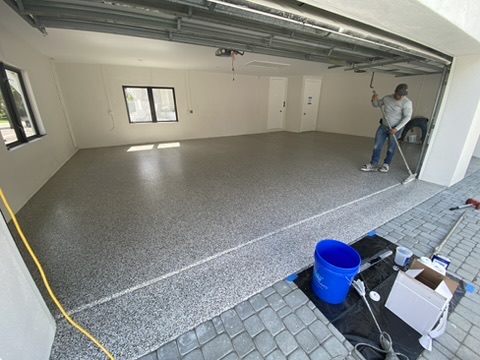
Two eras of Cape Coral concrete
Most of what we walk into falls into one of two groups. The 1970s and 1980s originals were poured before vapor barrier practice under residential slabs was what it is now, so the concrete often sits closer to bare sand than a modern pour does. Those slabs also carry decades of history: old paint, a sealer somebody rolled on in the nineties, patches at the door line, oil soaked in deep. The other group is the new construction going up across the north and northwest of the city, where the slab may still be giving up its own mix water. Both are workable, and not in the same way.
Want a straight answer on your own garage? Call (239) 300-0546 or send the details through our contact page and we will come look at the slab.
How the work runs.
Same sequence on every Cape Coral garage, from the canal-front originals to the new builds off Burnt Store Road.
We Come Read The Slab
No charge for the visit. We measure, check what the concrete is giving off for moisture, look at old coatings and stains, and go through color options with samples in hand. Written quote follows.
Diamond Grinding
We grind the slab with diamond tooling until we have clean, open concrete with a consistent profile. That opens the pores, pulls off old paint and the weak surface layer, and gives the system something mechanical to lock into. Acid washing does not do this.
Primer Matched To The Reading
The prime coat is picked to suit the moisture we found in step one, not chosen ahead of time off a truck. On a wetter Cape Coral slab that means a moisture-tolerant build. This is the coat cheap installs skip, and it is the one that decides how long the floor lives.
Color Coat And Flake
Pigmented base goes down and the flake blend is broadcast until the floor refuses to take any more, which is what gives full coverage with no thin patches. Once it sets we scrape the loose flake off and knock the surface flat.
Topcoat, Then Cure Time
The polyaspartic topcoat seals everything in and sets the hardness, the chemical resistance and the gloss. We watch slab temperature and dew point right up to the last coat. Walk on it the next morning, park on it the day after.
Closed-up houses and wet air.
A large share of Cape Coral sits empty for months at a time. That shapes both what we find and when we schedule.
A seasonal garage is its own environment. The door stays shut from spring to fall, nothing moves the air, and whatever comes up through the slab has nowhere to go, so the room holds warm damp air for months. On bare concrete that shows up as a chalky white bloom, a musty smell the first time the door rolls up, and rust on anything steel left sitting on the floor. On a painted floor it usually shows up as edges that have started to lift. A properly bonded, fully sealed floor is the one thing in that garage that does not care, because there is no open pore for moisture and salt to get into.
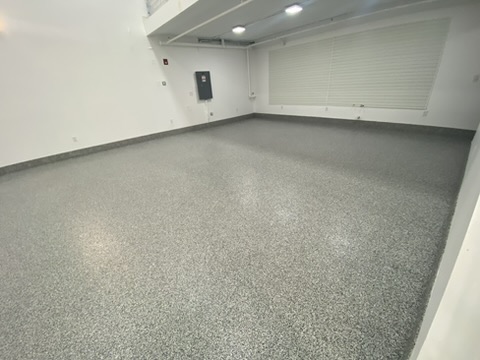
Timing follows the same logic. Epoxy Guys install year round, because waiting on a dry day in Southwest Florida is waiting forever. What we manage instead is the slab surface at the hour we coat it, and how close the concrete sits to the dew point in that garage.
Same thinking applies elsewhere on the property. We also handle pool deck coatings along the canal, anti-slip coatings for the wet paths, and metallic epoxy when you want more depth than flake. The full local list sits on our Cape Coral page.
We come to you.
Cape Coral sits inside our regular Lee County run. Free onsite quotes, no travel fees, and the same install standard as our work out of Naples.

Family-owned out of Naples since 2012. Cape Coral, FL gets the same install standard and the same real lifetime adhesion warranty as every other city we cover.
What Cape Coral owners ask us.
The questions that come up on nearly every quote out here. Ask us anything else.
Why do you read the slab for moisture before quoting a Cape Coral garage?
Our house sits closed up from May through October. Does that change anything?
Is there a season when a garage floor can actually be installed here?
What does canal air do to a garage floor over time?
My old floor peeled where the tires sit. Was that a bad product?
Cape Coral, FL
Schedule your garage floor quote in Cape Coral.
Free onsite quote anywhere in Cape Coral. We bring samples, read the slab, and put a written number in your hands within 24 hours. Epoxy Guys, installing across Southwest Florida since 2012.
Call or text any time

Epoxy Guys LLC
Coatings that stand up to Southwest Florida sun and salt air, installed by a Naples family since 2012.