Barefoot on the Lanai.
A screened deck in Estero has to grip when it is soaked, stay walkable at two in the afternoon, and hold its color under years of Lee County sun. Epoxy Guys build every deck around those three demands, then sort out the finish.
What an Estero lanai asks of a surface
Estero grew mostly as master-planned communities, so an enormous number of houses here share a similar footprint out back: a screened cage, a pool, and a band of concrete between the two that nobody thought much about when the house was handed over. That concrete carries wet feet, patio furniture, splash-out and a season of afternoon rain, and bare or painted slab handles roughly none of it gracefully.
The first thing an owner notices is grip going the wrong direction. A brushed slab that felt fine when the house was new gets polished smooth by traffic and cleaning, and the shady band along the cage wall picks up a film that turns slick before it looks green. The second is heat, because by August the open sections decide whether anyone walks out there without shoes.
A coated deck answers both, provided it is specified for the deck rather than pulled off a shelf: a texture chosen for how this family uses the pool, a color chosen for how much of the deck lives in full sun, and a topcoat rated for outdoor exposure instead of an interior product carried outside. Talk it through with us at (239) 300-0546 or through the project form.

The finish above is the shape most Estero pool decks take: a light speckled flake, a texture you can feel underfoot without it being harsh, and a clean line where the deck meets the coping.
The chips are broadcast into a wet base and sealed under a clear outdoor topcoat, so the texture is part of the floor rather than a layer waiting to wear off at the steps.
Grip, chemistry, drainage.
Three things touch an Estero pool deck constantly, and each one shapes a different part of the specification.
Wet grip comes first because it is the only part of a pool deck that can hurt somebody. We set the aggregate broadcast rate against how the deck actually gets used: a heavier, more open texture where there are step risers, a spa lip or a path children sprint along, and a gentler one on a sun shelf where people stretch out and a coarse surface stops being pleasant. Neither setting is a default, so it is a conversation on site rather than a line on an order form.
Water chemistry is second. Estero pools run the full range, traditional chlorine on some houses and salt systems on plenty of others, and the two leave different marks. Chlorinated splash-out concentrates along the same strip of deck day after day and hits hardest after a shock treatment. A sealed, non-porous surface holds both on top where a hose moves them, instead of letting them work down into open concrete.
Drainage is third and gets skipped the most. Deck drains, the slope away from the coping, and the low spot that always seems to sit near one cage corner all decide where water sits after a storm. We read the slope during the walkthrough and coat with it, because a fine finish over a section that ponds after every rain is a maintenance problem with a nice color.
The cage is part of the deck
An aluminum enclosure is not scenery around the job. Its footings are bolted straight through the slab at the deck perimeter, its kickplate sits flush against the concrete, and the screen channel runs an inch above the surface the whole way around. Each of those is a place where a rushed coating either stops badly or gets somewhere it should not be.
We terminate the coating cleanly at each footing so water sheds away from the metal rather than collecting against it, keep the finish out of the channel and off the kickplate entirely, and hand-detail the corners where a machine cannot reach. It is slower than running a roller to the edge, and it is the difference between a deck edge that still looks intentional in five years and one that has to be cut back and patched.
The cage also changes the physics of the slab. It throws shade across one side of the deck for most of the day, which slows drying and keeps the concrete underneath damper than an open patio would ever be. We prep those shaded zones harder and confirm the moisture reading before anything goes down, because a base coat bonded to a slab that has not released its water will let go later no matter how good the product is. Covered runs behave the same way, which is why the system carries out of the cage and down a walkway without changing character.
Five stages, one crew.
Epoxy Guys run our own people through every stage of an Estero deck. Nothing is handed to a sub.
Walkthrough
We read the slope, the shade, the cracking, the splash line and the cage detail, then ask how you use the deck. A written quote follows within a day, with the texture and color decisions already settled.
Strip and open
Mineral residue, biological film and any failing sealer come off, then the slab is ground until it has an open profile. Anything already lifting is removed rather than buried under new material.
Detail work
Every crack gets opened out and packed with a material that stays flexible. Footings, coping, deck drains and the kickplate line are cut in by hand so the finished edges land where we intend.
Base and broadcast
A moisture-tolerant base goes down in the dry part of the morning, and the aggregate is broadcast into it at the rate agreed at the walkthrough. Storm timing decides where we start.
Seal and hand over
The UV-stable clear coat locks the aggregate in. We walk the deck with you, point out the drainage lines, and leave cure times in writing before the trailer moves.
Scheduling around storms and seasons
From June onward the afternoon builds like clockwork, so deck work in Estero starts early. Base coat goes down while the slab is dry and the cell is still hours away. On a genuinely wet week we would rather move a start date than fight the sky, and we say so instead of pushing through and hoping.
Plenty of Estero houses empty out for the summer, and that turns out to be good timing rather than an obstacle. With water, gate access and a phone number, the whole job can happen while nobody is in the state. Owners come back in the fall to a deck that rinses clean instead of one that spent five months growing something in its pores. If a community association reviews exterior work, hand us the submittal list at the walkthrough.
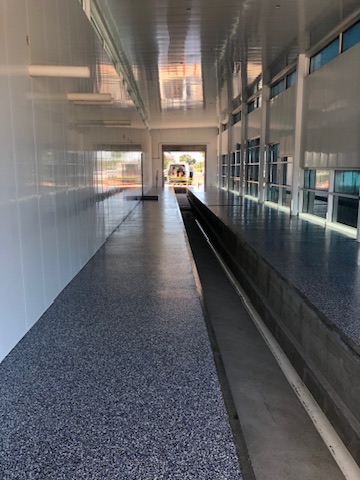
Most owners fold in neighboring work while our crew is already parked out front. The same texture carries down a walkway as an anti-slip coating, the garage floor is a natural pairing on the same visit, and interior spaces run metallic. For a clubhouse, association amenity deck or storefront entry, that is a commercial scope, and the outdoor grip specification is detailed on our anti-slip system page. Finished work sits in the project gallery, everything we cover locally is on the Estero page, and the wider footprint runs across Lee County. Ready to book? The contact form reaches us fastest.

Family-owned in Naples since 2012. Estero, FL sits inside the primary run Epoxy Guys work every week, so nothing here gets handed to a traveling crew.
Asked on Estero decks.
The questions that come up while we are standing on the slab. Send us a different one.
How much of the cage has to come apart before you start?
Our salt cell leaves white residue on the deck. Does that matter?
Can you keep the lanai walkable while the work is going on?
Will an August storm ruin the install?
Our community association reviews exterior work. Can you help with that?
We are not in Florida over the summer. Can the work happen while we are gone?
Where we run.
Estero is on our regular Lee County route. Free onsite walkthrough, no travel surcharge, the same install standard we hold in Naples.
Estero, FL
Walk your deck with us.
We come out to the lanai, read the slope and the shade, settle grip and color with you on the spot, and put a written number in your hands inside 24 hours.
Call or text any time

Epoxy Guys LLC
A Naples family business since 2012, coating garages, lanais, and storefronts across Southwest Florida.